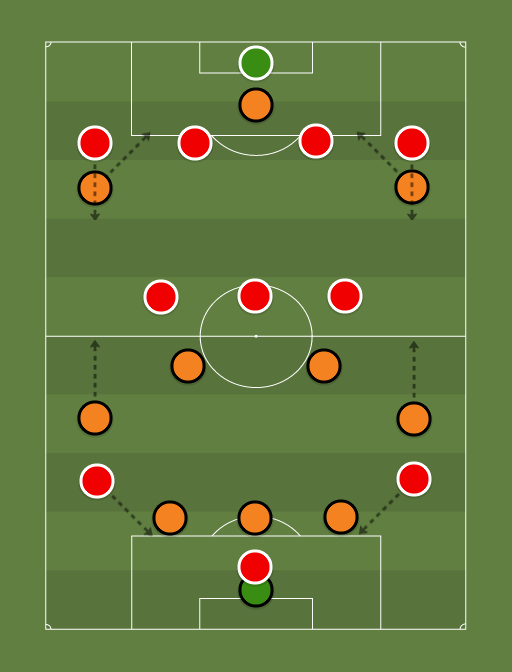
Wolves (3-4-3) vs Liverpool (4-3-3) - ShareMyTactics.com
Submitted on
Jurgen Klopp set Liverpool up in a 4-2-3-1 structure, with Georginio Wijnaldum and Jordan Henderson as the double pivot, Roberto Firmino playing as a number 10 behind Mo Salah, and Sadio Mané and Adam Lallana lining up as the wide attackers. They soon converted into a 4-4-2 diamond, however, with Henderson at the base, Wijnaldum and Lallana to the sides and Mané joining Salah on the top line. Firmino remained as the number 10, making frequent diagonal runs in behind the Wolves wing-backs – who were initially aggressive in their pressing of Liverpool full-backs Andy Robertson and Trent Alexander-Arnold. Direct running in behind from either Salah or Mané helped push the Wolves back three deep, which created extra space between the lines. The visitors narrowed to protect these, with Liverpool then building around and into their full-backs – who looked to cross from slightly deeper positions than usual in a bid to exploit any spaces beyond the back five. Wolves did well to limit Liverpool’s familiar access from full-back into the front line, however; their mid-block worked to negate the hosts’ attempted final-third penetrations. The increased attacking movements of Robertson and Alexander-Arnold did open up wider spaces for the Wolves forwards to spin into, but both Virgil van Dijk and Joe Gomez were commanding in these scenarios. The only advantage Wolves’ structure allowed was that it gave them two permanent central threats – Diogo Jota and Pedro Neto – against the Liverpool centre-backs, although Henderson’s deeper position at the base of the diamond gave the hosts adequate cover.