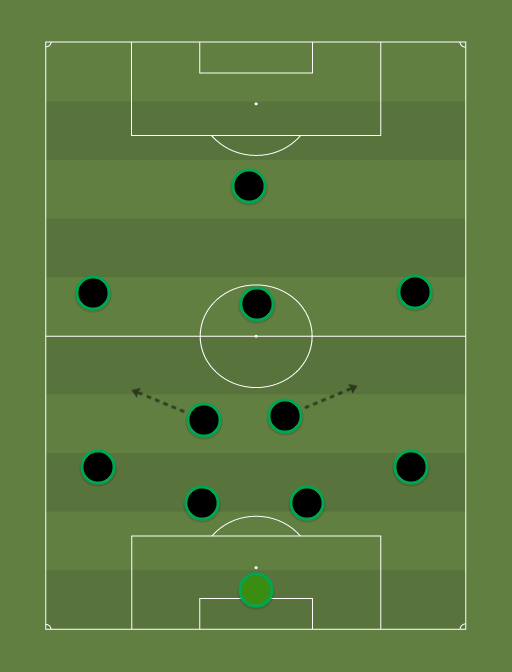
NEXT GENERATION (4-2-3-1) - FRIENDLY - - ShareMyTactics.com
Submitted on
IMPORTANT!!!!!!!!!!!! . BEFORE YOU START READYING PLEASE LOOK AT YOUR POSITION AND OTHER PEOPLES POTIONS TO SEE WHAT THEY CAN DO TO HELP YOU IN THE GAME AND ALSO WHAT THEY SHOULD BE DOING TO HELP YOU ON SATURDAY PLEASE REVISE THE POTIONS RELEVANT TO YOU THANK YOU Striker: In this formation, the striker should not lack support as he has three players whose job it is to supply him with ammunition. If the players behind the main striker are of genuine quality, the formation can be a dream for a striker as he should receive plenty of balls into the penalty area. The 4-2-3-1 formation can accommodate a big target man who can hold the ball up and lay it off for the oncoming midfielders, or a more nimble striker capable of running on to balls and finishing chances. It is important that the front-man is a strong physical specimen as, despite the support from midfield, he will need to hold off defenders as he looks to carve out chances for himself or teammates. midfield 3 The midfield of the 4-2-3-1 formation is very flexible. Number 10 constitutes a real "playmaker" and the two wing players are nearly equal to real wing attackers or wingers. Constant advances of the players in the offensive (alternating, if possible) cause problems and confusion for the opposing defense. Due to this offensive, a 4-3-3 often automatically results when in possession of the ball. Requirements concerning the willingness to run and tactical discipline are very high but mandatory in order to successfully play these frequent system changes. The 2 - (double six) It's actually superfluous, but we will go into it anyway. Our "sixes" need to possess a high degree of footballing intelligence and the ability to "read" a game. But all players need that nowadays, don't they? The "double six" is often interpreted in the following way as part of this system of play: one of the "sixes" is more offensively oriented, is often unmarked in the midfield and thus can be passed to, additionally takes care of the playmaking and secures the rear space behind number 10 if his team is in possession of the ball. The second "six" is mostly responsible for defensive tasks. Ideally, the two players swap their roles in the system of play time and time again, in order to become less predictable. In the defensive, the "sixes" may easily form triangles with two players of the "four back" on their sides and thus heavily attack the opposing player in possession of the ball. Gaps for possible passing routes are automatically closed in the process and if possession of the ball is won, it is easy to find access to the wing players in the midfield. However, the running paths are often very long as described above and it is often hard to support the wing-backs. 4 Defenders A "four back" is situated in front of the goal keeper (players 2 to 5). Players 2 and 5 are the wing-backs while 4 and 3 are the center-backs. Today's wing-backs are fast, agile, confident with the ball and often join the attacking play in a quick-witted and clever manner. A very good technical education is important for every position today. In this system, the wing-backs are often faced with the difficult problem that they cannot be immediately supported by their fellow team mates; running paths are often very long for defensive players. For this reason, the wing-backs have to be strong tacklers that are capable of delaying the opponent's attack. Goalie The tasks of the goal keeper have been detailedly described as part of other systems of play/formations and a number of articles. Similar to the 4-2-3-1, he is the first attacker and the last defender. Due to the "double six" and the good defensive behavior of the midfielders, the pass ways into the joints of the "four back" are well blocked. In case of inaccurate passes by the attackers or passes above or via the "four back", the goal keeper should secure and command the rear space.